Historical
Historical record.

History

History, told from the original papers. Each entry is a dated step in the long argument over what an electron is, with the papers it rests on. Every source is listed in sources.bib, and when I get one wrong, it goes on the corrections ledger. A date marked c. is an estimate; the record gives no exact day.

Each entry says whether it was checked against the original paper or letter, or against secondary sources only.

Timeline

  1. Hamilton discovers quaternions on Brougham Bridge
    Fields and ether, 1840–1904 · Theory · Vectors and quaternions · Checked against the original

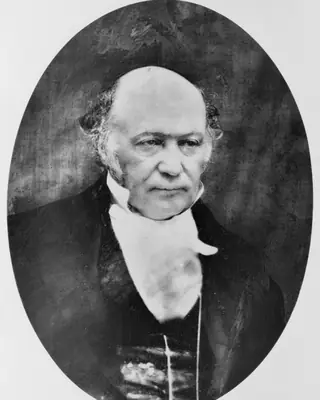
    William Rowan Hamilton in his fifties, head and shoulders, facing slightly right.
    Photographed at Fulneck, 1857 or 1859; published 1885. Image: Unknown photographer. Public domain, via Wikimedia Commons.

    Walking along the Royal Canal in Dublin to a meeting of the Royal Irish Academy, William Rowan Hamilton saw how to multiply numbers in four parts, which he called quaternions: i squared = j squared = k squared = ijk = -1. He cut the formula into a stone of Brougham Bridge with a knife. He later told the story in an 1865 letter to his son.

    William Rowan Hamilton

    1. Letter to Rev. Archibald H. Hamilton, 5 August 1865. William Rowan Hamilton. Trinity College Dublin, History of Mathematics archive (1865). Original letter · Free full text Primary

    Further reading: Hamilton’s Research on Quaternions (Trinity College Dublin); William Rowan Hamilton (MacTutor, University of St Andrews).

    Checked
  2. Read

    Kelvin proposes that atoms are vortex rings

    Fields and ether, 1840–1904 · Theory · Vortex atoms, The ether, Topology and knots · Checked against the original

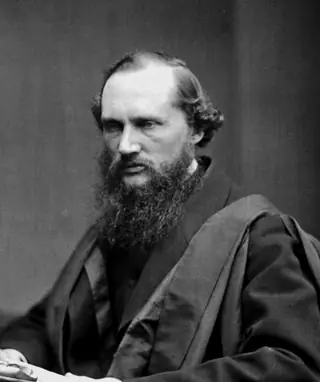
    William Thomson in his forties, with a full dark beard, seated in an academic gown and holding papers.
    Photograph published in 1871, in Memorials of the Old College of Glasgow. Image: Thomas Annan. Public domain, via Wikimedia Commons.

    William Thomson, later Lord Kelvin, read ‘On Vortex Atoms’ to the Royal Society of Edinburgh. Building on Helmholtz’s theorems on vortex motion and Tait’s smoke-ring demonstrations, he proposed that atoms are vortex rings in a perfect fluid filling space, and that knotted or linked rings could account for the different elements.

    William Thomson (Lord Kelvin)

    1. On Vortex Atoms. William Thomson (Lord Kelvin). Proceedings of the Royal Society of Edinburgh 6, 94–105 (1867), no. 73. Free full text Primary

    Further reading: William Thomson (MacTutor, University of St Andrews).

    Checked
  3. Published

    Michelson and Morley look for Earth’s motion through the ether

    Fields and ether, 1840–1904 · Experiment · The ether · Checked against the original

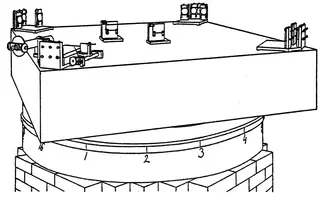
    Engraving of a large square stone slab carrying mirrors and a lamp, resting on a ring-shaped float above a brick pier.
    Fig. 3 of Michelson and Morley's 1887 paper: the apparatus in perspective. Image: Albert A. Michelson and Edward W. Morley. Public domain, via Wikimedia Commons.

    Albert Michelson and Edward Morley used a rotating optical interferometer in Cleveland to look for the Earth’s motion through the luminiferous ether, the medium then thought to carry light. The fringe shift they saw was far smaller than the ether theory of the day predicted. They published the result in the American Journal of Science in November 1887.

    Albert A. Michelson, Edward W. Morley

    1. On the Relative Motion of the Earth and the Luminiferous Ether. Albert A. Michelson and Edward W. Morley. American Journal of Science (Third Series) 34 (203), 333–345 (1887). Original paper doi:10.2475/ajs.s3-34.203.333 · Free full text Primary

    Further reading: November 1887: Michelson and Morley report their failure to detect the luminiferous ether (APS News); Albert Abraham Michelson 1852–1931 (American Institute of Physics).

    Checked

  4. Received

    Einstein’s “On the Electrodynamics of Moving Bodies”

    Relativity, 1905–1924 · Theory · Relativity, Electromagnetism · Checked against the original

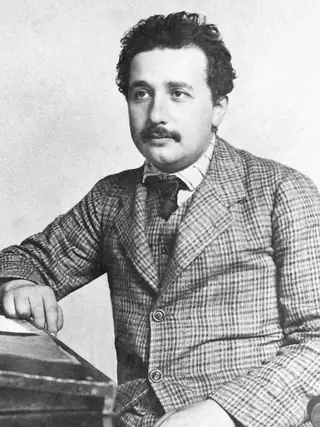
    Albert Einstein in his mid-twenties, in a checked suit, seated with one arm on a sloping desk.
    At the patent office in Bern, about 1904–05. Image: Unknown photographer (attributed to Lucien Chavan). Public domain, via Wikimedia Commons.

    Albert Einstein’s paper, received by Annalen der Physik on 30 June 1905, set out special relativity. It rests on two postulates: the laws of physics are the same for every observer in uniform motion, and light in empty space always travels at the same speed. From these he derived new rules for space, time and electromagnetic fields, and applied them to the motion of the electron.

    Albert Einstein

    1. Zur Elektrodynamik bewegter Körper. Albert Einstein. Annalen der Physik 17 (10), 891–921 (1905). Original paper doi:10.1002/andp.19053221004 · Free full text Primary

    Further reading: Einstein’s Discovery of Relativity (American Institute of Physics); Einstein: Image and Impact (American Institute of Physics).

    Checked

  5. Published

    Dirac’s relativistic equation for the electron

    Quantum electron, 1925–1949 · Theory · Quantum theory, Spin and magnetic moment, The g-factor · Checked against the original

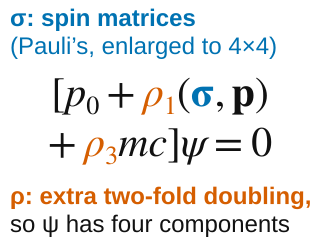
    Dirac's 1928 equation for the electron, written in his original notation.
    Dirac's equation in his original 1928 notation (eq. 9), typeset by us. Diagram: The Electron Plumber.

    Paul Dirac published a wave equation for the electron that agrees with special relativity. The electron’s spin and its magnetic moment come out of the equation on their own instead of being added by hand. It gives the electron a magnetic moment of one Bohr magneton, a g-factor of exactly 2.

    Paul A. M. Dirac

    1. The Quantum Theory of the Electron. Paul Adrien Maurice Dirac. Proceedings of the Royal Society of London. Series A 117 (778), 610–624 (1928). Original paper doi:10.1098/rspa.1928.0023 · Free full text Primary

    Further reading: January 1928: The Dirac equation unifies quantum mechanics and special relativity (APS News); “Theory of Electrons and Positrons”, Nobel Lecture 1933 (Nobel Prize).

    Checked

  6. Published

    Schwinger calculates the electron’s extra magnetic moment

    Quantum electron, 1925–1949 · Theory · Quantum theory, The g-factor · Checked against the original

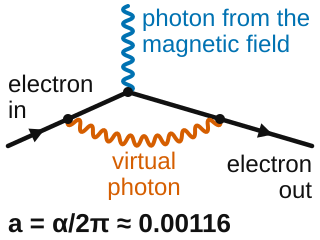
    Modern diagram of an electron emitting and reabsorbing a photon while interacting with a magnetic field, labelled alpha over two pi.
    Modern depiction of Schwinger's 1948 result, α/2π. His letter had no diagrams; Feynman first published his in 1949. Diagram: The Electron Plumber.

    Julian Schwinger used quantum electrodynamics to calculate the first correction to Dirac’s value of the electron’s magnetic moment. The extra part is alpha divided by 2 pi, about 0.00116, where alpha is the fine-structure constant. He published it as a short letter in the Physical Review.

    Julian Schwinger

    1. On Quantum-Electrodynamics and the Magnetic Moment of the Electron. Julian Schwinger. Physical Review 73, 416–417 (1948). Original paper doi:10.1103/PhysRev.73.416 · Free full text Primary

    Further reading: “Relativistic Quantum Field Theory”, Nobel Lecture 1965 (Nobel Prize); Julian Schwinger (MacTutor, University of St Andrews).

    Checked
  7. Published

    A single trapped electron gives a new magnetic moment and fine-structure constant

    Precision, 1950–present · Measurement · The g-factor, Spin and magnetic moment · Checked against the original

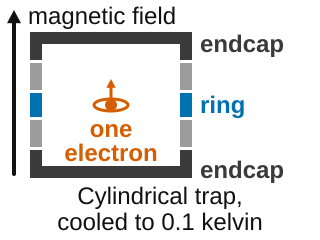
    Cross-section of a cylindrical trap: stacked ring electrodes around a single electron, with the magnetic field running vertically.
    Schematic, not to scale: a cylindrical Penning trap holding one electron, the kind used at Harvard in 2008. Diagram: The Electron Plumber.

    At Harvard, David Hanneke, Shannon Fogwell and Gerald Gabrielse measured the magnetic moment of a single electron held in a trap. They reached a precision better than one part in a trillion, and used the result to determine the fine-structure constant.

    David Hanneke, Shannon Fogwell, Gerald Gabrielse

    1. New Measurement of the Electron Magnetic Moment and the Fine Structure Constant. D. Hanneke, S. Fogwell and G. Gabrielse. Physical Review Letters 100, 120801 (2008). Original paper doi:10.1103/PhysRevLett.100.120801 · Free full text Primary

    Further reading: Searching for New Physics with the Electron’s Magnetic Moment (APS Physics).

    Checked

  8. Published

    The electron’s magnetic moment measured to 0.13 parts per trillion

    Precision, 1950–present · Measurement · The g-factor, Spin and magnetic moment · Checked against the original

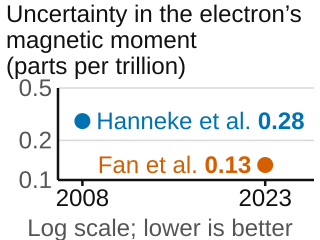
    Chart: the uncertainty in the electron's magnetic moment falling from 0.28 parts per trillion in 2008 to 0.13 in 2023.
    How precisely the electron's magnetic moment is known, 2008 to 2023. Diagram: The Electron Plumber.

    With a new apparatus at Northwestern University, Xing Fan, Thomas Myers, Benedict Sukra and Gerald Gabrielse measured the magnetic moment of a single trapped electron. Their value of g/2 is 1.001 159 652 180 59, uncertain by 0.13 parts per trillion, about twice as precise as the 2008 result.

    Xing Fan, Thomas G. Myers, Benedict A. D. Sukra, Gerald Gabrielse

    1. Measurement of the Electron Magnetic Moment. X. Fan et al. Physical Review Letters 130, 071801 (2023). Original paper doi:10.1103/PhysRevLett.130.071801 · Free full text Primary

    Further reading: Searching for New Physics with the Electron’s Magnetic Moment (APS Physics).

    Checked

Subscribe

New episodes, notes, and corrections.

Episodes publish on YouTube. Notes and standing corrections publish on GitHub.